Default Rule
The default rule defines the fallback behavior when no other rules match. This is the last step in the evaluation order, making it crucial for your flag's behavior.
Audience Traffic Allocation
The Audience Traffic Allocation feature allows you to control what percentage of your total traffic receives the flag evaluation, with the remainder excluded entirely. This is particularly useful for:
- Controlled experiments - Test on 10% of traffic while excluding 90%
- Beta launches - Gradually expose features to increasing audience percentages
- Risk mitigation - Limit exposure during initial rollouts
For example, you can set the audience allocation to 10%, then apply a 50/50 rollout split within that 10% audience. This means only 5% of your total users receive each variation, while 90% are excluded from the experiment entirely.
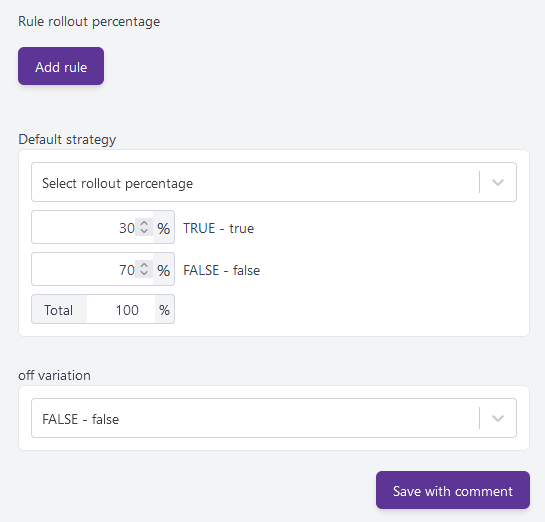
Variation Allocation
Within the audience that receives the flag (determined by Audience Traffic Allocation), you can distribute users across variations using either:
- Split equally - Automatically divides traffic evenly across all variations
- Split by custom percentage - Manually define the percentage for each variation
The audience split happens first, then the variation allocation applies to the included audience.
Progressive Rollout Restriction
If you have a progressive rollout running, you cannot modify the default rule until the rollout completes.
The progressive targeting tab now lets you select both a control and a target variation, supporting flags with three or more variations.
Common Use Cases
- A/B testing - Split traffic 50/50 between control and treatment variations
- Canary releases - Start with 5% traffic, gradually increase
- Multi-variant testing - Test 3+ variations with custom percentages
- Feature ramp-up - Begin with small audience, expand over time
- Percentage-based rollout - Release to 25% of users not matching any rules
Best Practices
When launching a new feature, start with a small audience allocation (5-10%) in the default rule. Monitor performance and gradually increase the percentage.
Users excluded by Audience Traffic Allocation will receive the OFF variation, not a random variation from your flag. Consider this when designing your feature logic.